Final Reflection of Digital Business Model BEMM129


Created by Jing Jing usinCanva

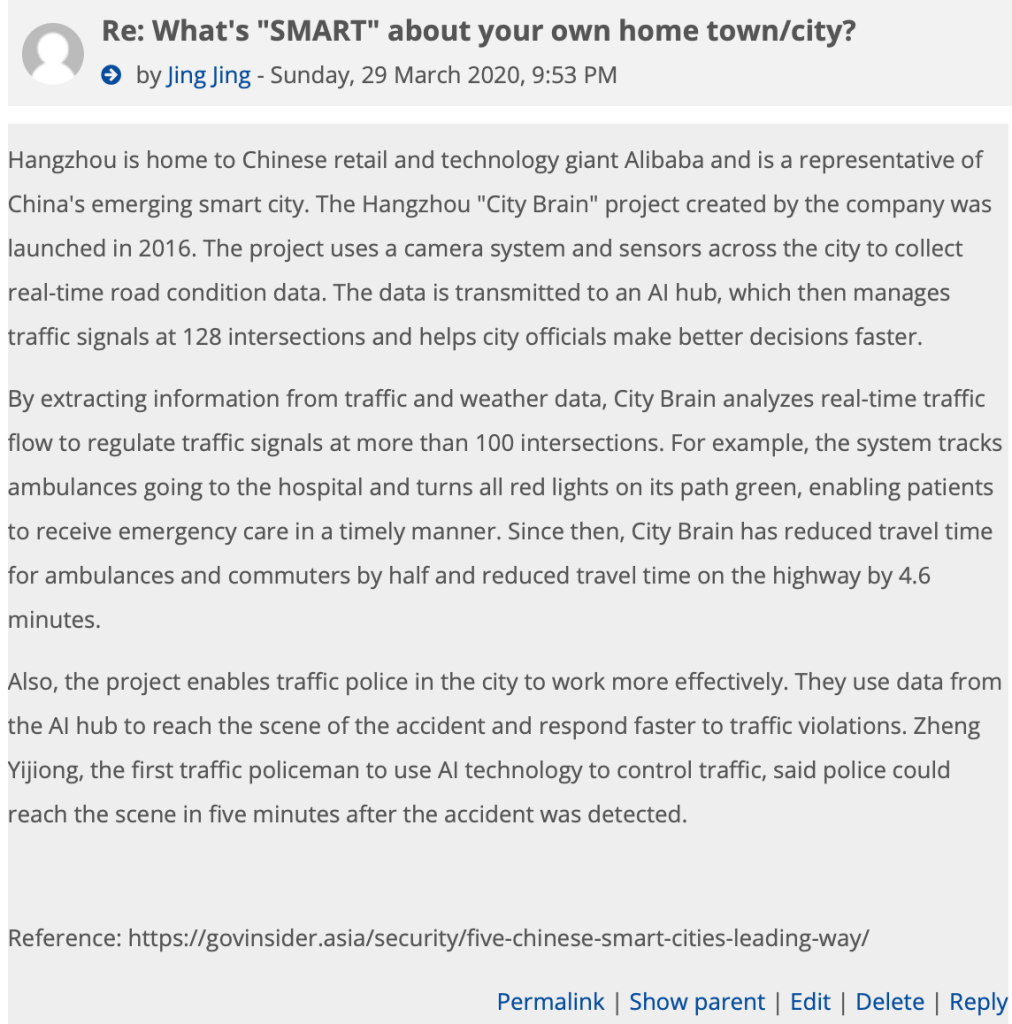
In terms of Gibbs’s research in 1988, individuals should process their thoughts and feelings because if people do not reflect immediately, they might forget in the future. Therefore, reflection plays a crucial role in the study (Gibbs, 1988). Now it’s time to finish my journey of this course, and BEMM129 is a unique module, which focused on learning based on the connection with the online world. Students publish blogs and interact with others to comment, which is an excellent method to spread their thinking. The weekly online discussion’s format is very innovative, students could absorb much knowledge; at the same time, they may also better understand the current development of various industries on the basis of the digital economy, which is an ideal combination of theories and practice. My learning process of BEMM129 is shown on the left.

1. My learning key point

All discussions in this course are due to the development of the digital business. In the era of artificial intelligence, machines summarize rules from “specific” large amounts of data, synthesize some “specific knowledge,” and apply this “knowledge” to real-world scenarios to solve practical problems (Xiaoqiang, 2020). The most worrying issue for all walks of life based upon the digital economy is that people will lose their jobs in the future. This unemployment problem is also my focus from the perspective of the financial industry. But in fact, the current digital business development is not enough to replace all human work (Thompson, 2019). Humans have various abilities, including emotional recognition, communicating skills, and so on. Only human knowledge can form a network structure and can be integrated, yet today’s digital technology cannot realize cross-field working. For example, economic problems could also use biological knowledge. The invention of AI and big data is just a tool and a logical summary, it has limitations and can only solve specified tasks.

2. Engaging with classmates

Besides, through comparison with others in module learning, I also found the shortcomings of my view. For instance, organizations that use digital business models to take advantage of their functions are not redefining their work, but using digital tools to enhance connections with customers to provide better services. Therefore, I was not very successful in choosing the Alibaba group. On the one hand, the organization is too huge to analyze; On the other hand, it is a company that started with digital business, rather than an organization that changes business strategy through digital activity. Additionally, by reviewing peers’ blog, I found that Siying Lu’s critical analysis of Zara and Xiyao Zheng’s successful use of digital models in KFC, they were all utilizing digital models to optimize their organizations, however, I paid too much attention to the growth history of Alibaba.
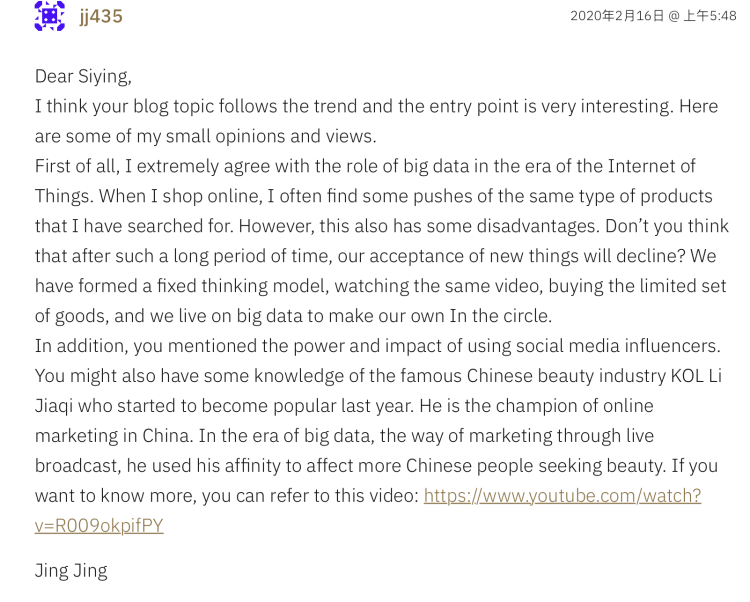
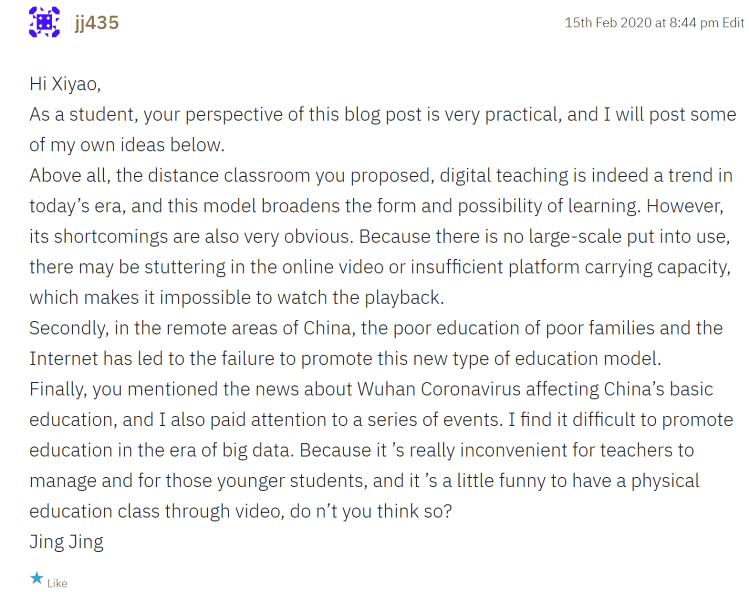
My contributions of 4 comments

Comment’s link:

Siying Lu’s blog of Marketing: https://kasiying.design.blog/2020/01/31/how-digital-economy-influence-my-job-role/

Xiyao Zheng’s blog of teachers: https://xydigital.business.blog/2020/02/09/the-impact-of-digital-economy-development-on-the-profession-of-teachers/

Siying Lu’s blog of Zara: https://kasiying.design.blog/2020/02/28/118/

Xiyao Zheng’s blog of KFC: https://xydigital.business.blog/2020/03/02/the-secrets-of-kfcs-successful-digital-transformation-in-china/

3. Discussions and Future outlook

Apart from blogs, learning documents were uploaded in different forms each week, such as the MOOC, Ted speeches, and professional reports. Overall, I consider 3D printing and the fourth digital revolution in the MOOC are the most interesting, and the circular economy in ELE allows me to understand the digital economy at a macro level. Ultimately, for in-depth research, I used many examples and references to prove my comments. In a word, the role of digital technology is changing from improving marginal efficiency to promoting innovation and disruption (DMI, 2019).
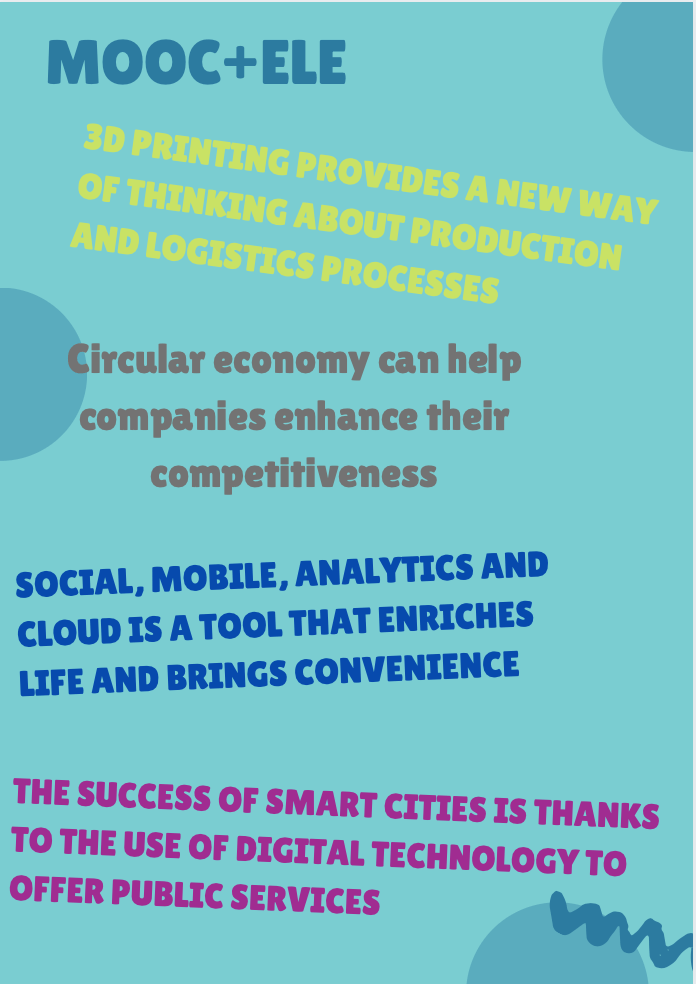
Created by Jing Jing usinCanva

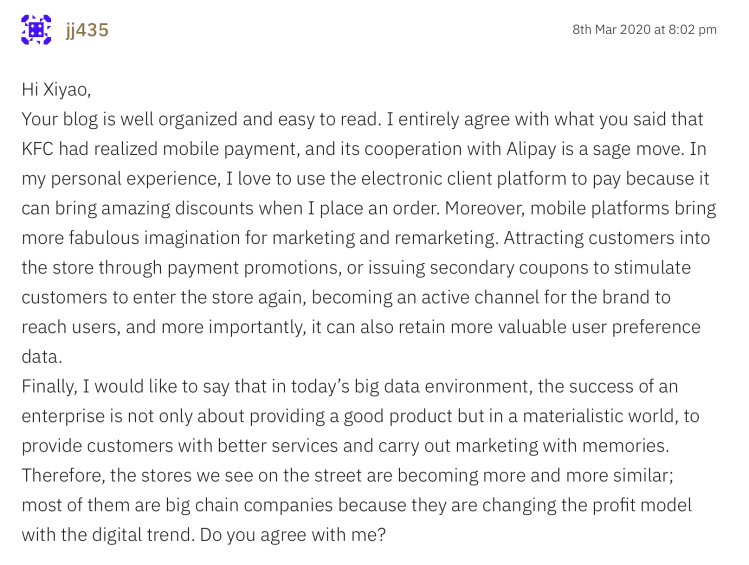
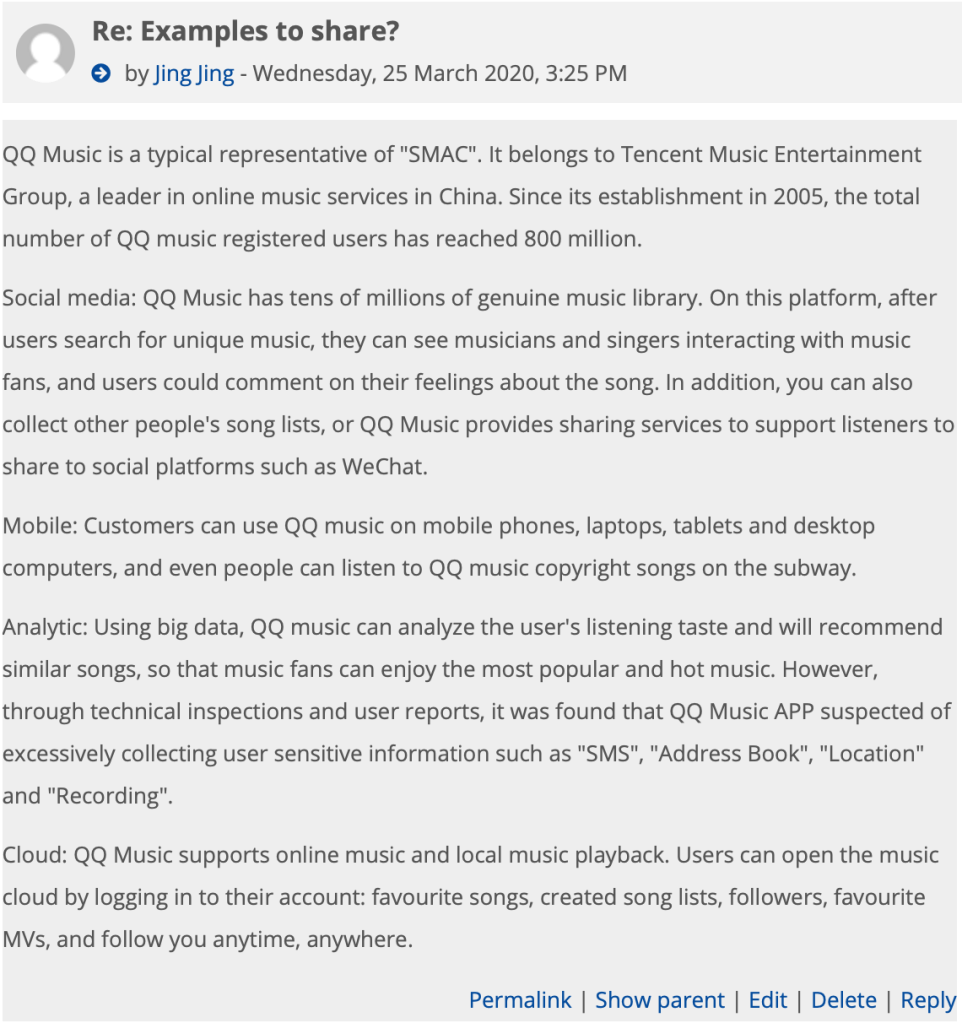
What did I learn from the MOOC and ELE?
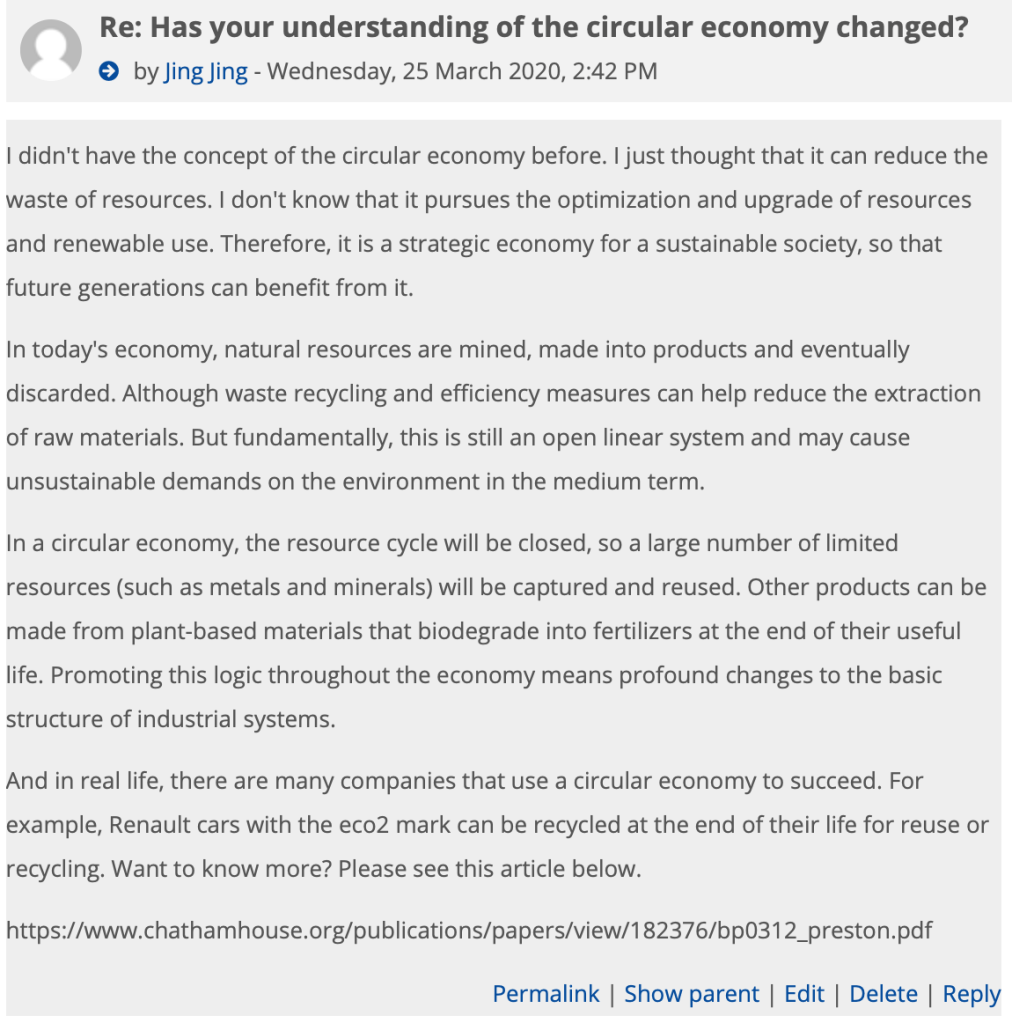
My contributions on ELE from week 5-10

After introducing the content of the module from blogs to comments, my expectations for the development of digital commerce will be displayed by a video as follows.

Video made by Jing Jing on Biteable Retrieved from: https://www.youtube.com/watch?v=sFU9bHPg-WY

Reference

DMI, S. (2019, November 15). The Future of Digital Transformation: What Does it Look Like & How to Plan For It? Retrieved from https://digitalmarketinginstitute.com/blog/the-future-of-digital-transformation-what-does-it-look-like

Gibbs, G. (1988). Learning by doing: A guide to teaching and learning methods. Oxford: Further Education Unit, Oxford Polytechnic.

Thompson, E. (2019, August 20). Why AI Can Never Replace a Good Employee. Retrieved from https://www.bbvaopenmind.com/en/technology/artificial-intelligence/why-ai-can-never-replace-a-good-employee/

Xiaoqiang, D. (2020). The article “Update 2020” understands artificial intelligence-AI, how to not be unemployed in the intelligent age?. Retrieved from https://easyai.tech/en/ai-definition/ai/

Alibaba’s Development Under Digital Bussiness

As of February 25, 2020, Alibaba’s market capitalization was US $ 551.595 billion. This number ranks among the top ten in the world and is the highest valued Chinese company. At the same time, the economic situation in China shrouded in a new coronavirus is not optimistic (Munster et al., 2020). Alibaba cooperated with the Chinese government to build a “digital epidemic prevention system.” This system has the functions of information collection, real-time dynamics of the epidemic situation, online intelligent consultation, and personnel inquiries on the same trip, etc., to realize digital epidemic prevention and control. Alibaba is the epitome of the development of Chinese Internet companies in the digital economy era.

In 20 years, Alibaba has grown from a small business into a huge Alibaba digital economy, with more than 110,000 employees. It spans fields such as business, finance, logistics, and cloud computing (Clark, 2018).

The rapid development of the Internet has enabled China’s digital economy to grow from scratch and grow from small to large. Research institutions estimate that the digital economy currently accounts for more than 30% of China’s GDP (Zhang and Chen, 2019). The digital economy is becoming a new driving force for economic development in China and the world, and it is also a core component of national competitiveness in the future.

Why did Alibaba go to this day? How can we take a path to the digital economy era? Can China see more Alibaba in the future? This is a question in many people’s hearts.

Start-up

On the fifth day of 1999, Alibaba held its first full-member conference, one of the most famous scenes in the history of Internet development in China. Ma Yun made a light-hearted speech for more than two hours, telling Alibaba’s mission, vision and the future of the Internet.

Jack Ma’s speech at home in 1999. Retrieved from https://www.youtube.com/watch?v=Up9-C4_8dVo.

But soon, the burst of the U.S. Internet bubble quickly passed to China, and Alibaba, which had not yet found a profit model, was worried internally and externally, and the capital chain was on the verge of breaking.

Jack Ma then started Alibaba’s “Long March” road and carried out drastic strategies and organizational adjustments: closing overseas offices, shrinking business, achieving independence, and not relying on venture capital.

Retail platform

In 2003, Alibaba began preparations for the establishment of Taobao.com. Alibaba started as a B2B business, while Taobao is a C2C model. The biggest rival is eBay. At that time, eBay had occupied 90% of the Chinese C2C e-commerce market, and was later acquired by the US retail website giant eBay.

The media called the match “ant vs. elephant” (Chen, 2007). Different from eBay’s payment and commission model, the free Taobao network attracted a large number of merchants to flock to it, but it was the launch of the Alipay secured transaction that established the victory, which completely eliminated people’s online shopping inconvenience and trust doubts.

In just over a year, Taobao was on par with eBay. Until 2005, Alibaba acquired all of Yahoo’s business in China and acquired Yahoo China’s operating rights. Knowing that there was no chance, eBay quickly sold eBay and withdrew from the Chinese market.

E-commerce ecosystem

In September 2007, Alibaba held a strategy meeting in Ningbo. At that time, the group was chaotic and there were fierce conflicts between businesses. There was no consensus on which direction the company should go. It was at this meeting that Alibaba established a strategy for the next 10 years to “build an open, collaborative, and prosperous e-commerce ecosystem”, and the core of this system is data. Therefore, Alibaba Cloud, Cainiao Network, and Ant Financial were subsequently established (Tse, 2015).

On November 6, 2007, Alibaba ushered in the first highlight moment in the history of development, and the B2B business was successfully listed in Hong Kong.

Defining the Digital Age

But Alibaba is not in this way all the way, the era of the mobile Internet has come.

In 2011, WeChat was born, allowing Tencent to be the first to get a ticket for the mobile Internet (Schulte and Lee, 2019). In the Internet world where elephants may fall at any time, Alibaba is facing a thrilling moment.

In this rudder process, Alibaba raised the power of the entire group, “All in Wireless”, and focused on building mobile Taobao, achieving a successful transformation.

On September 20, 2014, Alibaba Group landed on the New York Stock Exchange, setting the world’s largest IPO record in history.

Development in the new era

Internet companies such as Ali, born in the era of the digital economy, will have a very different temperament from the big companies in the industrial era.

At the end of 2015, Alibaba Group announced the full launch of the “China-Taiwan Strategy.” The company integrates product technology and data capabilities to build the middle stage, so that the front-line business becomes small enough, and the middle stage becomes strong enough, so that the entire company has the ability to quickly innovate. Later stories, everyone has already seen (Fan et al., 2018). The rise of a series of innovative businesses, such as cost-effective, flying pigs, and word of mouth, are all closely related to the China-Taiwan strategy.

Statistics show that in 2018, Alibaba and Ant Financial Services paid a total of 51.6 billion yuan in taxes to the state, driving more than 250 billion yuan in taxes for upstream and downstream industries; creating 40.82 million jobs, including 15.58 million direct jobs and 25.24 million driven types of job opportunities; Alibaba’s China retail platform GMV has grown from zero to 5.7 trillion (Terada et al., 2019).

“Let the world have no difficult business” is not empty words. Through Internet technologies and methods, Alibaba is helping to solve many problems such as difficulties in trade for SMEs, high thresholds for entrepreneurship, high operating costs, high logistics costs, difficult financing, and expensive financing. Alibaba has formed a commercial operating system, and it is also a digital system. Alibaba’s commercial operating system is designed to empower merchants to make it easier and more efficient to do business in the digital economy era.

Alibaba and Digital Business

The big wave of the digital economy is accelerating and sweeping every corner of every industry, reshaping business and changing society. On the consumer side, the degree of digitalization of Chinese consumers can be said to be leading the world, but it is clear that the road to digital transformation for the future has just begun. Subversive changes are taking place in consumers and markets, and changes are being forced on the supply side as well.

What is revealed behind Alibaba’s growth history is that the 20 years of China ’s digital economy taking off is a history of solving social problems and creating value for China and the world. Alibaba’s practice of helping small and medium-sized businesses to run their businesses and allowing consumers to buy quality goods wherever they are, has created the world’s most prosperous e-commerce. Alibaba’s independent research and development of computing power has helped enterprises to cultivate digital internal skills and brought a vibrant cloud computing. Alibaba has improved the efficiency of social resource utilization and spawned a shared business model. The digital economy has spawned a large number of fast-growing emerging companies, and one-third of the world’s “unicorn” companies were born in China.

Source of pictures: Retrieved from http://www.vcg.com

Reference:

Clark, D. (2018). Alibaba: the house that Jack Ma built. HarperCollins Publishers.

Chen, H. (2007). Analysis of the Reasons for Ebay’s Defeat in China——Comparison with Taobao. Property Guide, 000 (005), 20-21.

Fan, J., Tang, L., Zhu, W., & Zou, B. (2018). The alibaba effect: Spatial consumption inequality and the welfare gains from e-commerce. Journal of International Economics114, 203-220.

Munster, V. J., Koopmans, M., van Doremalen, N., van Riel, D., & de Wit, E. (2020). A novel coronavirus emerging in China—key questions for impact assessment. New England Journal of Medicine382(8), 692-694.

Schulte, P., & Lee, D. K. C. (2019). Alibaba vs Tencent: The Great Race (pp. 163-194). World Scientific Publishing Co. Pte. Ltd..

Terada-Hagiwara, A., Gonzales, K., & Wang, J. (2019). Taxation Challenges in a Digital Economy—The Case of the People’s Republic of China.

Tse, E. (2015). China’s disruptors: How Alibaba, Xiaomi, Tencent, and other companies are changing the rules of business. Penguin.

Zhang, M. L., & Chen, M. S. (2019). China’s digital economy: Opportunities and risks. International Monetary Fund.

The Financial Industry Under the Impact of Digital Economy and Artificial Intelligence

Around 2020, the logic of economic growth and wealth in many countries will change significantly. The world is at the turning point of technological revolution from “informatization” to “intellectualization”. These great changes make many professions present different characteristics from before. The financial industry has been at the top of many industries. What kind of changes will happen in the digital economy? What is the development trend of the financial industry in the future?

1. What is the impact on the financial industry?

It’s not surprising that people want to learn finance. In the past decade, the financial industry has definitely been at the top of the career chain (Carnevale et al., 2013), with many parents and young people scrambling to enter the financial industry. The major of Finance in colleges and universities has always been the most competitive.

But this logic is no longer absolute truth. In the next decade, many employees in the financial industry will face a high risk of unemployment. For example, traditional grassroots positions such as bank tellers and lobby managers will disappear in large numbers. 

In China, China’s four major banks have laid off nearly 80000 people in recent years (Zhang, 2019). Why? Because the bank realizes the intelligent network, all kinds of intelligent machines can now undertake more than 90% of the business.

The former most attractive credit officers also face the risk of being laid off. Like Alibaba’s e-commerce bank, which serves tens of millions of small and micro enterprises a year (12.27 million in 2018), it uses the zero manual intervention lending process based on big data and artificial intelligence technology, which can complete the application within three minutes and receive the loan within 10 seconds. There is not a single credit officer in the whole bank.

Also, investment bank traders and even data analysts are out of work. Goldman uses software engineers to replace traders, and about one software engineer can replace four traders. Now this trend is still spreading. Some studies estimate (Yang, A., 2018) that in the five years from 2020 to 2025, about 10% of the jobs on Wall Street will disappear.

These are not individual cases. Many people don’t realize that finance is actually an industry with a high probability of AI substitution.

Frey and Osborne (2017) did a study, and they calculated the probability that different industries could be replaced by artificial intelligence. According to their data ranking, the probability of AI substitution in the financial industry is as high as 69% on average. 

In addition to credit officers, there are many jobs in the financial industry, such as budget analysts, insurance contractors, accountants, tax inspectors, all of which are more than 90% likely to be replaced by artificial intelligence. By contrast, the probability of service industry being replaced by AI is only 43% on average.

2. Jobs in the financial industry are mostly “codeable”

It’s easy to understand that assembly line workers are replaced by robots, but why industries with high education and threshold like finance are also high-risk industries in the era of artificial intelligence?

This is actually a very different place in this technological revolution of artificial intelligence. Most of the previous technological revolutions (Bessen, 2016) replaced human power with machinery, which did not involve our most proud “brain power” activities. Therefore, most of the positions based on the ability of “reading, writing and calculating” are the “white-collar high-end jobs” in the minds of people in the last era.

But the emergence of “artificial intelligence” began to invade human brain activity.

What is encoded work? The essence of artificial intelligence is actually “data intelligence”, which means that human beings find the rules of behavior, make algorithms, and then rely on massive big data to let computers learn and simulate the process, and then make decisions. Therefore, as long as there are many repeatable details and clear task objectives in the work content of any kind of occupation, it is easy to be coded and programmed by computer algorithm – this kind of work is called “coding” work. In the future, in these jobs, the computer will use the powerful computing power to quickly grasp and optimize these skills through the learning of massive data, leaving human far behind.

For example, data reading, memory, retelling, data analysis, summary – these are originally high threshold human skills, but under the impact of artificial intelligence, these skills will depreciate rapidly, and the skills of related professions will be destroyed in a flash (Xu Xianjun, 2018).

Unfortunately, a lot of jobs in the financial industry are “codeable”. The tellers, financial managers and credit auditors are all highly “procedural” and “process” jobs, such as reading materials, checking reports, making phone calls, reviewing information and evaluating risks according to models. The impact of AI on them is much greater than we think.

3. What will happen to the financial industry in the future?

As we have said before, a large part of financial practitioners will be replaced by artificial intelligence. Does that mean that they will not learn finance or need financial industry in the future?

The answer is No. Because finance is a big industry, there are many sub occupations, and the gap of AI substitution probability of each sub occupation is very large: in the financial industry, about 60% of the positions have a high AI substitution probability, more than 90%, but 25% of the positions have a low AI substitution probability, less than 30% (Wolla, 2018).

In fact, in industries such as finance, all kinds of subdivided occupations present a “pyramid” shape: most of the grassroots to middle-level positions are coded, while a small number of positions at the top of the pyramid are more “irreplaceable”, and the wealth of the industry will be more inclined to these positions.

For example, bankers, most of their jobs are “finding resources, coordinating relations and balancing interests”. These top-level positions are not “Data-Driven”, but “people-oriented”. These skills are just the most non coding and non procedural.

Good fund managers, even quantitative fund managers, are not “dependent on data” as many people think (Pupillo et al., 2018). Data is just their tool and reference. Their decision-making depends on the combination of experience, intuition, decisiveness and judgment, which will not be replaced.

Speaking of this, you may understand. Under the impact of artificial intelligence, a pyramid like career like finance will present two aspects. On the one hand, a large number of positions that can be coded will be replaced, and on the other hand, the positions at the top of the pyramid will get higher profits.

Source of pictures: Retrieved from www.visualchina.com

Reference:

Bessen, J. E. (2016). How computer automation affects occupations: Technology, jobs, and skills. Boston Univ. school of law, law and economics research paper, (15-49).

Carnevale, A. P., Smith, N., Stone III, J. R., Kotamraju, P., Steuernagel, B., & Green, K. A. (2013). Career clusters: Forecasting demand for high school through college jobs, 2008-2018.

Frey, C. B., & Osborne, M. A. (2017). The future of employment: How susceptible are jobs to computerisation?. Technological forecasting and social change, 114, 254-280.

Official website of Alibaba e-commerce bank:https://loan.mybank.cn/index.html

Pupillo, L., Noam, E., & Waverman, L. (2018). The Internet and Jobs. CEPS Policy Insights.

Wolla, S. A. (2018). Will Robots Take Our Jobs?. Page One Economics®.

Xu Xianjun. (2018). The limits and the future of artificial intelligence. Natural dialectics, 40 (1), 27-32.

Yang, A. (2018). The war on normal people: The truth about America’s disappearing jobs and why universal basic income is our future. Hachette UK.

Zhang. (2019). The bank of China international finance research institute expects GDP growth at 6.5% this year. The Chinese national power, (1), 25.

Welcome

My name is Jing Jing, and I am a postgraduate student from the University of Exeter. My major is international business.

Before I became a postgraduate student, I studied at Shandong Agricultural University, majoring in business administration and German. When I was in the fourth year of university, I completed my studies in Germany. Therefore, I had the opportunity to travel to some European countries and experience different cultures and customs.

I was born in Zibo City, Shandong Province, a northern inland industrial city. Zibo was the birthplace of the world’s first football “Cuju”. In addition, Zibo also has a worldwide-famous writer Pu Songling. The famous film “painting skin” is based on his novel Liao Zhai Zhiyi.

The reason I choose the digital business is that I can make and publish my own blog. This work is free to choose themes, which is challenging and creative. However, I have not studied related knowledge before, so I still need to make efforts on it.

通过 WordPress.com 设计一个这样的站点
从这里开始