
Created by Jing Jing using Canva
In terms of Gibbs’s research in 1988, individuals should process their thoughts and feelings because if people do not reflect immediately, they might forget in the future. Therefore, reflection plays a crucial role in the study (Gibbs, 1988). Now it’s time to finish my journey of this course, and BEMM129 is a unique module, which focused on learning based on the connection with the online world. Students publish blogs and interact with others to comment, which is an excellent method to spread their thinking. The weekly online discussion’s format is very innovative, students could absorb much knowledge; at the same time, they may also better understand the current development of various industries on the basis of the digital economy, which is an ideal combination of theories and practice. My learning process of BEMM129 is shown on the left.
1. My learning key point
All discussions in this course are due to the development of the digital business. In the era of artificial intelligence, machines summarize rules from “specific” large amounts of data, synthesize some “specific knowledge,” and apply this “knowledge” to real-world scenarios to solve practical problems (Xiaoqiang, 2020). The most worrying issue for all walks of life based upon the digital economy is that people will lose their jobs in the future. This unemployment problem is also my focus from the perspective of the financial industry. But in fact, the current digital business development is not enough to replace all human work (Thompson, 2019). Humans have various abilities, including emotional recognition, communicating skills, and so on. Only human knowledge can form a network structure and can be integrated, yet today’s digital technology cannot realize cross-field working. For example, economic problems could also use biological knowledge. The invention of AI and big data is just a tool and a logical summary, it has limitations and can only solve specified tasks.
2. Engaging with classmates
Besides, through comparison with others in module learning, I also found the shortcomings of my view. For instance, organizations that use digital business models to take advantage of their functions are not redefining their work, but using digital tools to enhance connections with customers to provide better services. Therefore, I was not very successful in choosing the Alibaba group. On the one hand, the organization is too huge to analyze; On the other hand, it is a company that started with digital business, rather than an organization that changes business strategy through digital activity. Additionally, by reviewing peers’ blog, I found that Siying Lu’s critical analysis of Zara and Xiyao Zheng’s successful use of digital models in KFC, they were all utilizing digital models to optimize their organizations, however, I paid too much attention to the growth history of Alibaba.
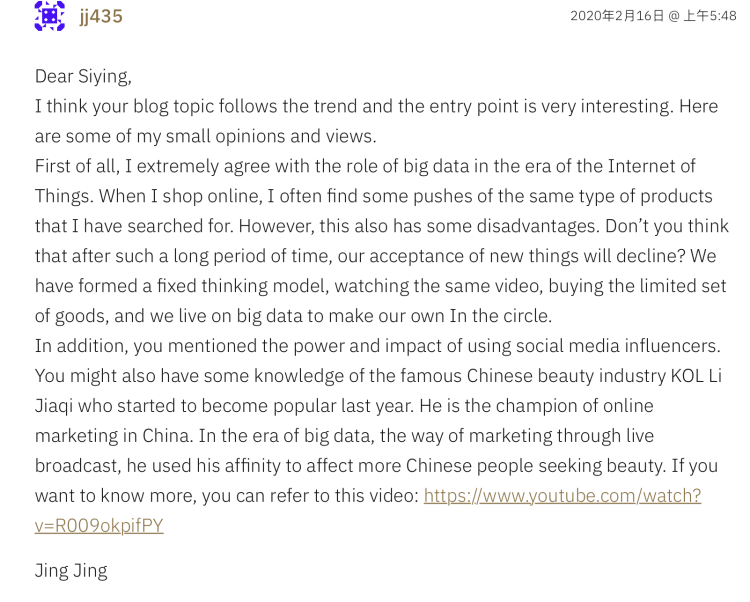
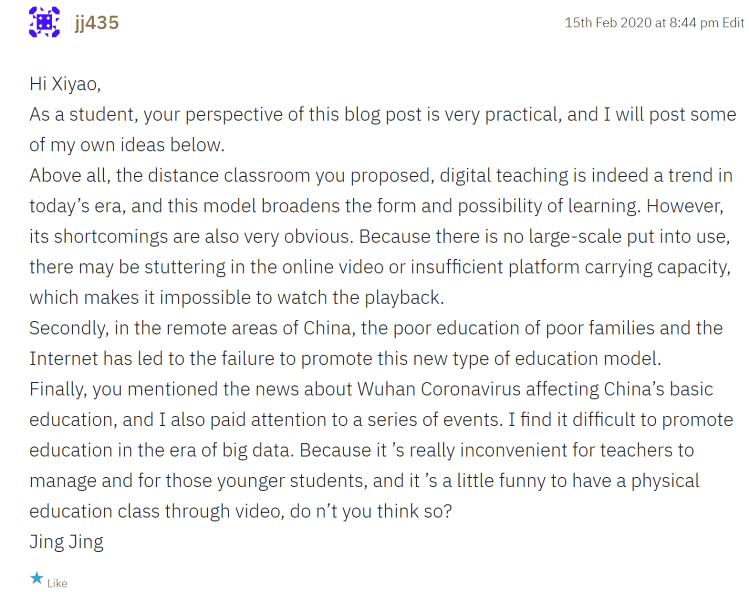

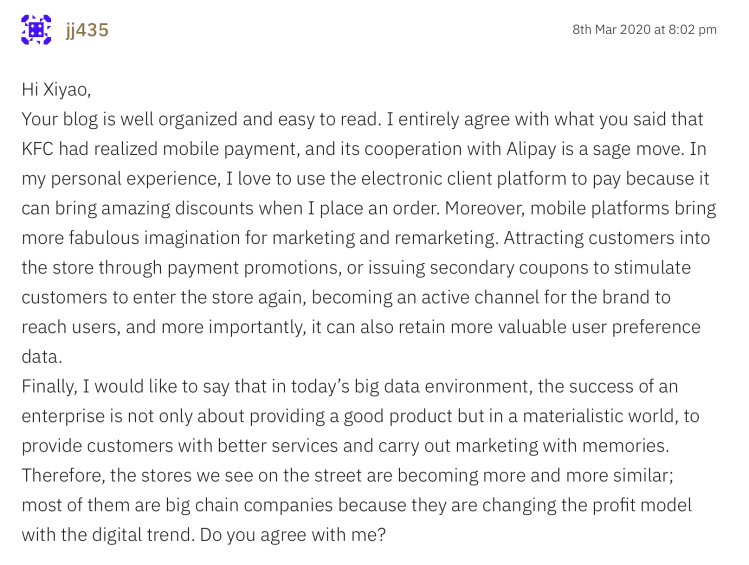
My contributions of 4 comments
Comment’s link:
Siying Lu’s blog of Marketing: https://kasiying.design.blog/2020/01/31/how-digital-economy-influence-my-job-role/
Xiyao Zheng’s blog of teachers: https://xydigital.business.blog/2020/02/09/the-impact-of-digital-economy-development-on-the-profession-of-teachers/
Siying Lu’s blog of Zara: https://kasiying.design.blog/2020/02/28/118/
Xiyao Zheng’s blog of KFC: https://xydigital.business.blog/2020/03/02/the-secrets-of-kfcs-successful-digital-transformation-in-china/
3. Discussions and Future outlook
Apart from blogs, learning documents were uploaded in different forms each week, such as the MOOC, Ted speeches, and professional reports. Overall, I consider 3D printing and the fourth digital revolution in the MOOC are the most interesting, and the circular economy in ELE allows me to understand the digital economy at a macro level. Ultimately, for in-depth research, I used many examples and references to prove my comments. In a word, the role of digital technology is changing from improving marginal efficiency to promoting innovation and disruption (DMI, 2019).
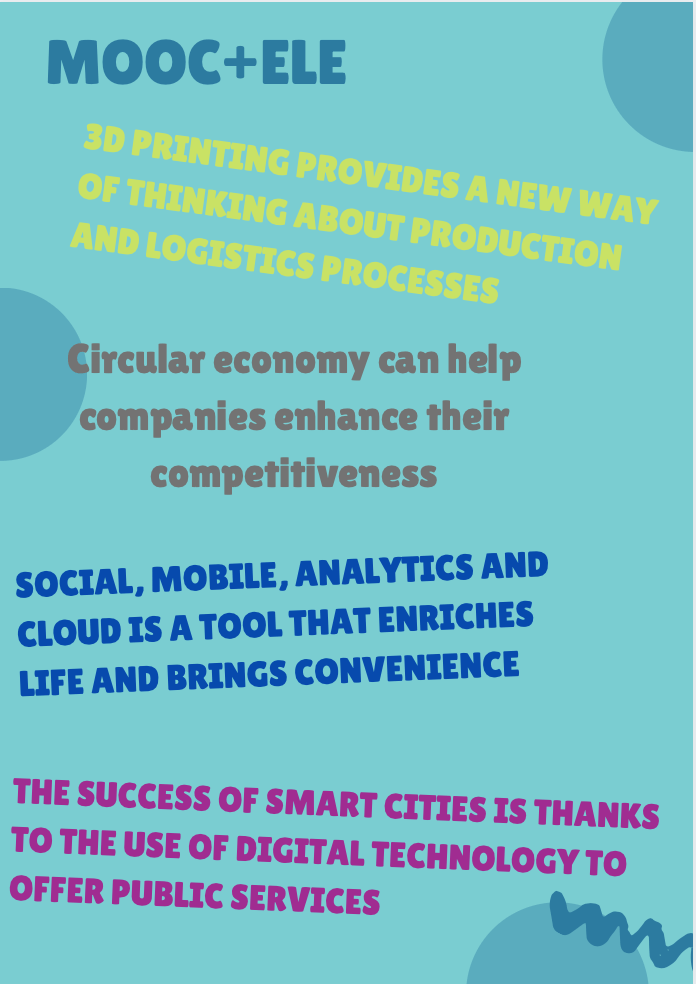
What did I learn from the MOOC and ELE?
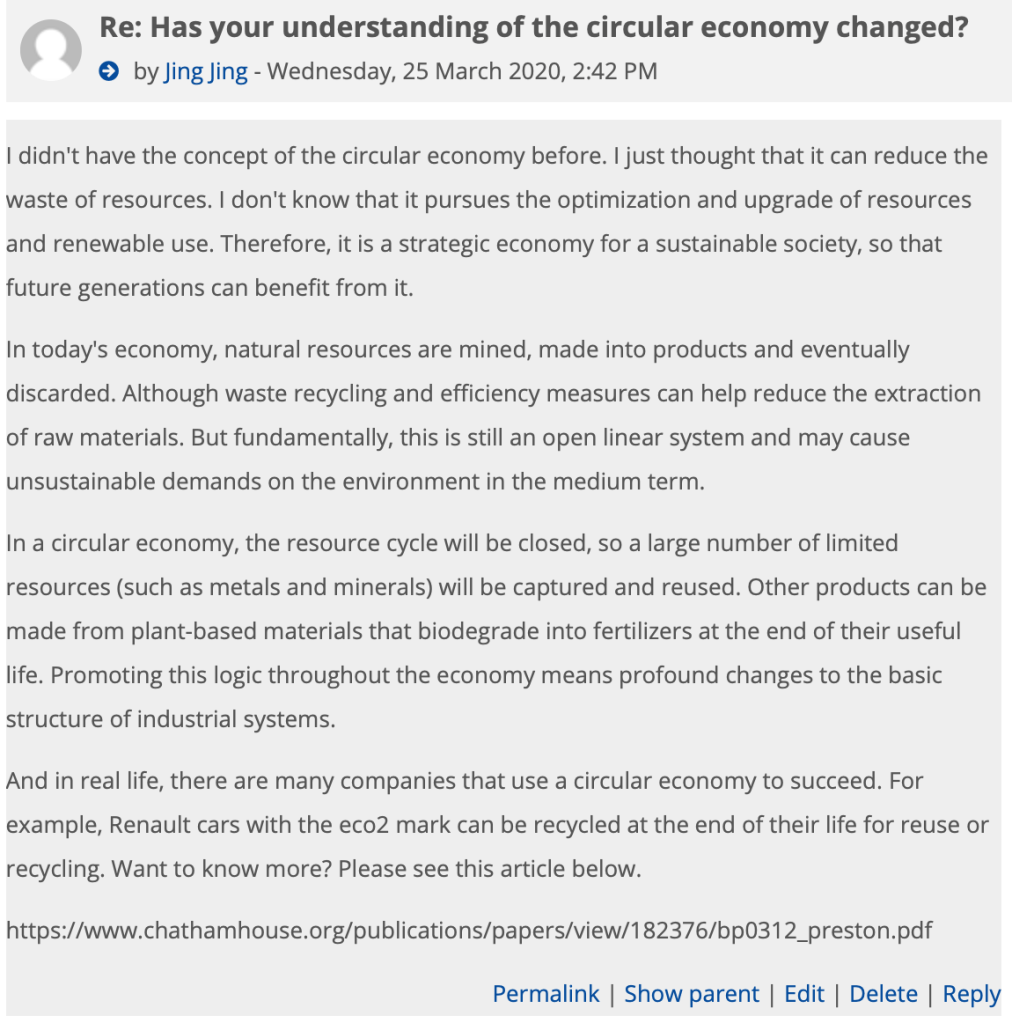
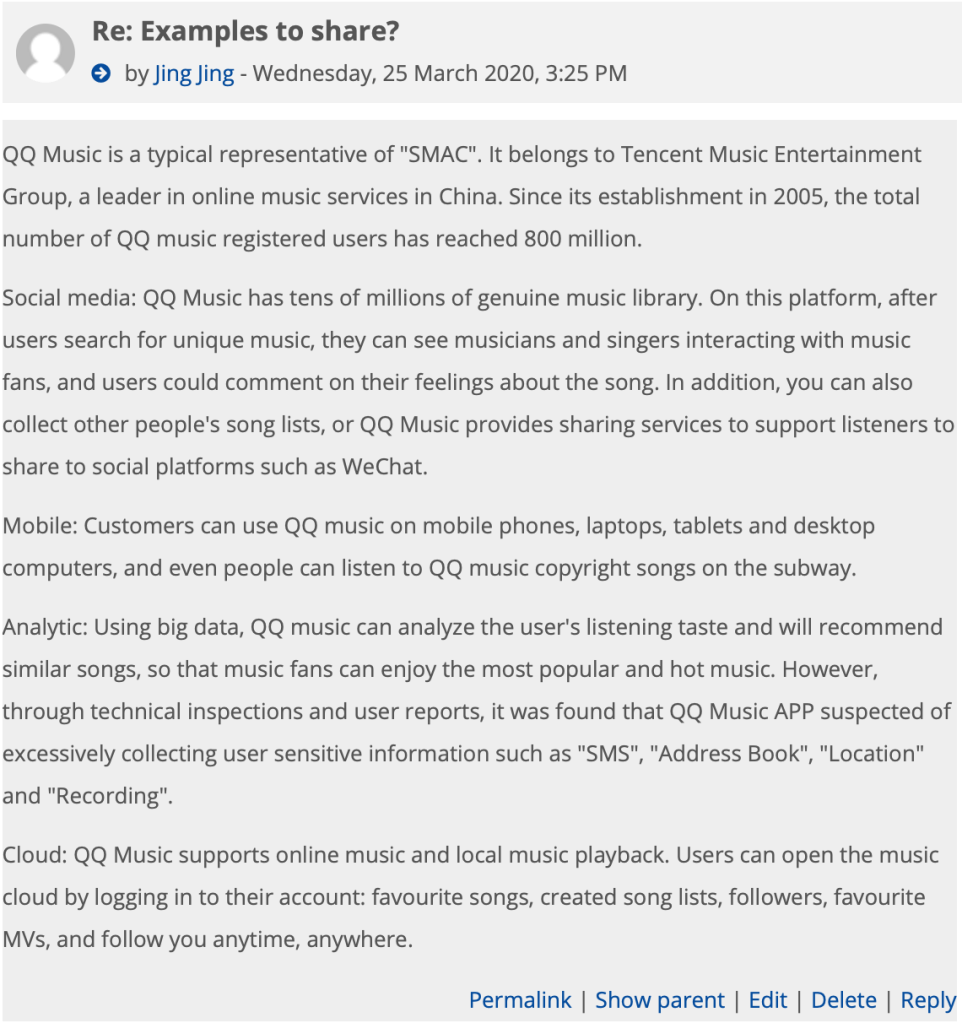


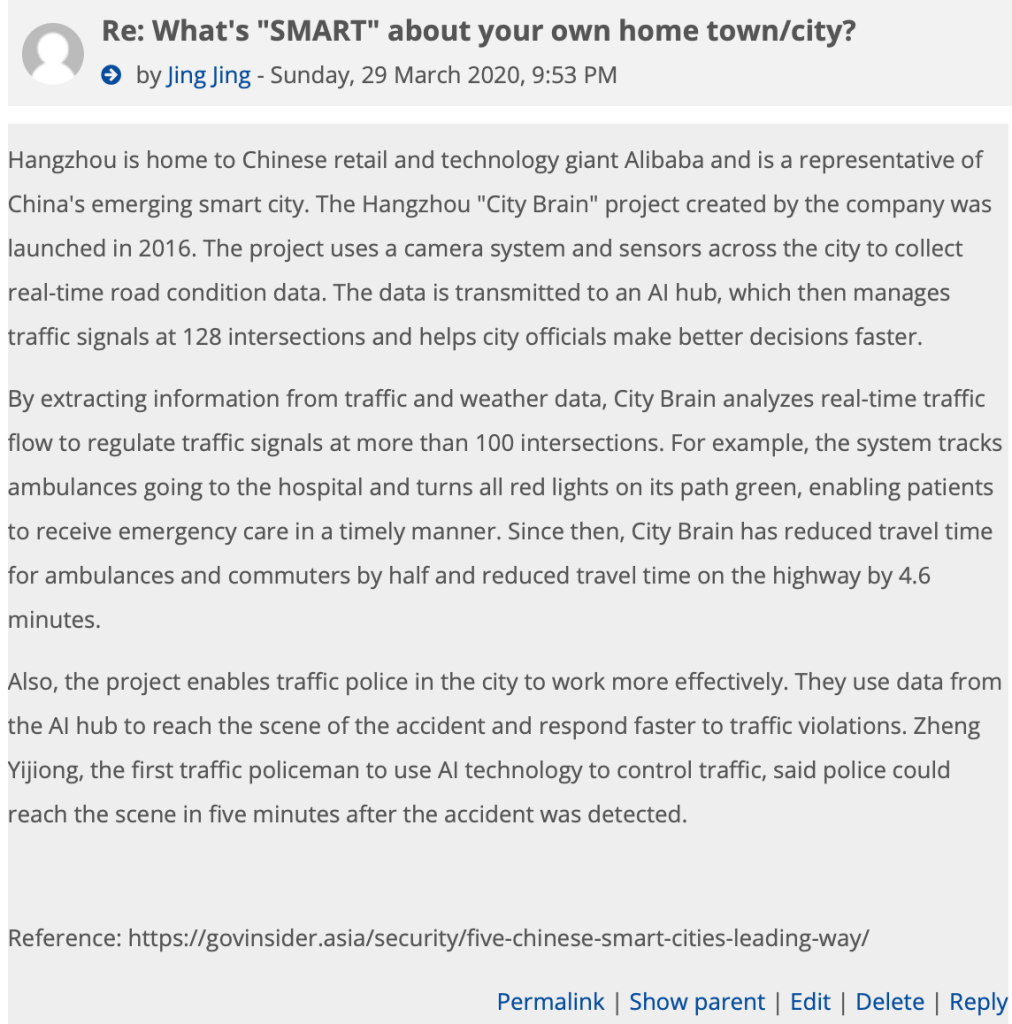
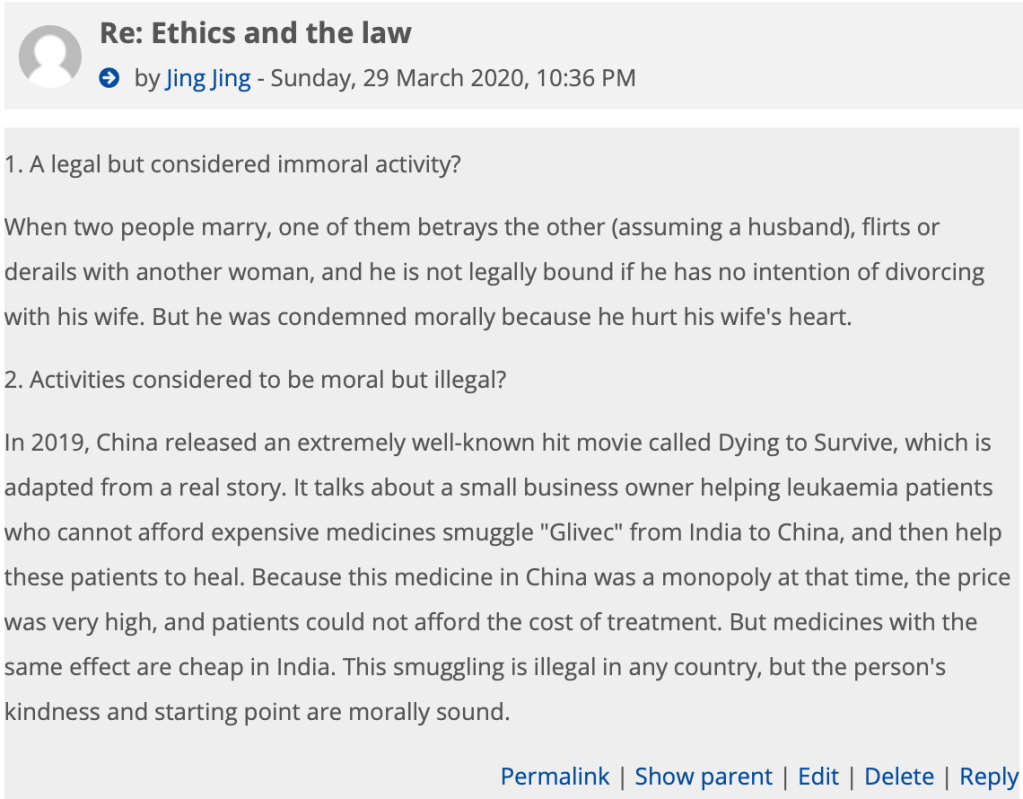
My contributions on ELE from week 5-10
After introducing the content of the module from blogs to comments, my expectations for the development of digital commerce will be displayed by a video as follows.
Reference
DMI, S. (2019, November 15). The Future of Digital Transformation: What Does it Look Like & How to Plan For It? Retrieved from https://digitalmarketinginstitute.com/blog/the-future-of-digital-transformation-what-does-it-look-like
Gibbs, G. (1988). Learning by doing: A guide to teaching and learning methods. Oxford: Further Education Unit, Oxford Polytechnic.
Thompson, E. (2019, August 20). Why AI Can Never Replace a Good Employee. Retrieved from https://www.bbvaopenmind.com/en/technology/artificial-intelligence/why-ai-can-never-replace-a-good-employee/
Xiaoqiang, D. (2020). The article “Update 2020” understands artificial intelligence-AI, how to not be unemployed in the intelligent age?. Retrieved from https://easyai.tech/en/ai-definition/ai/
 ewig
ewig 